
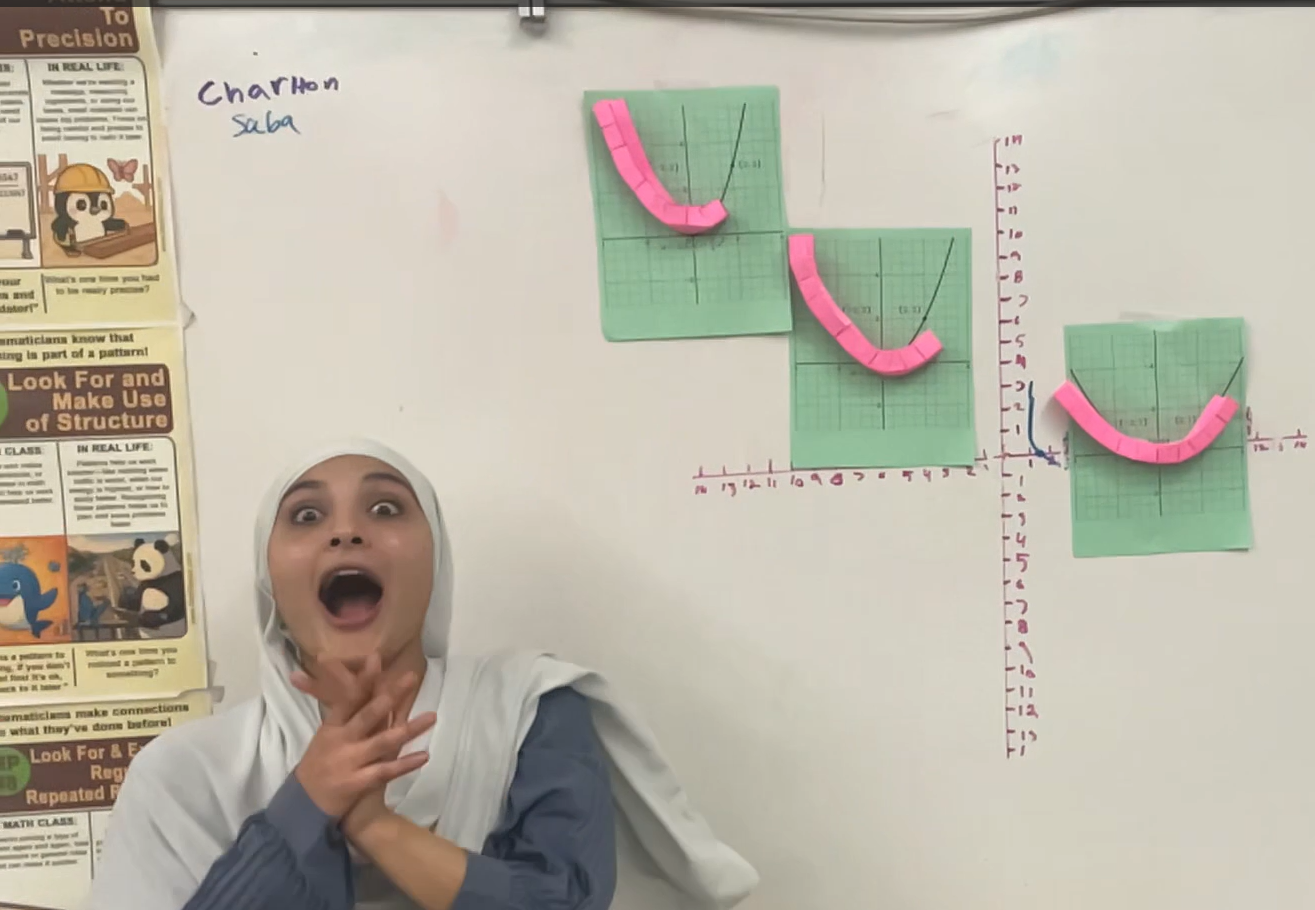
In the 3 Jumps Project, students design and construct a three-jump marble system using parabolic tracks and model both the physical jumps and the marble’s flight mathematically. Inspired by snowboard and mountain bike terrain parks, students explore how parabolas describe real-world motion and how transformations affect their shape and position.
Students begin by drawing a coordinate plane with one-inch increments and designing three distinct parabolic tracks that meet required parameters. Each track must use a different “a” value template and be constructed using only provided materials. The marble must travel unassisted from the start of the first parabola and launch off the final jump.
After building and testing their system, students record a working video of the marble completing all three jumps. Using a screenshot embedded into Desmos, each student scales the image and writes equations in vertex form:
to model:
- Each physical parabolic track
- Each parabolic flight path of the marble
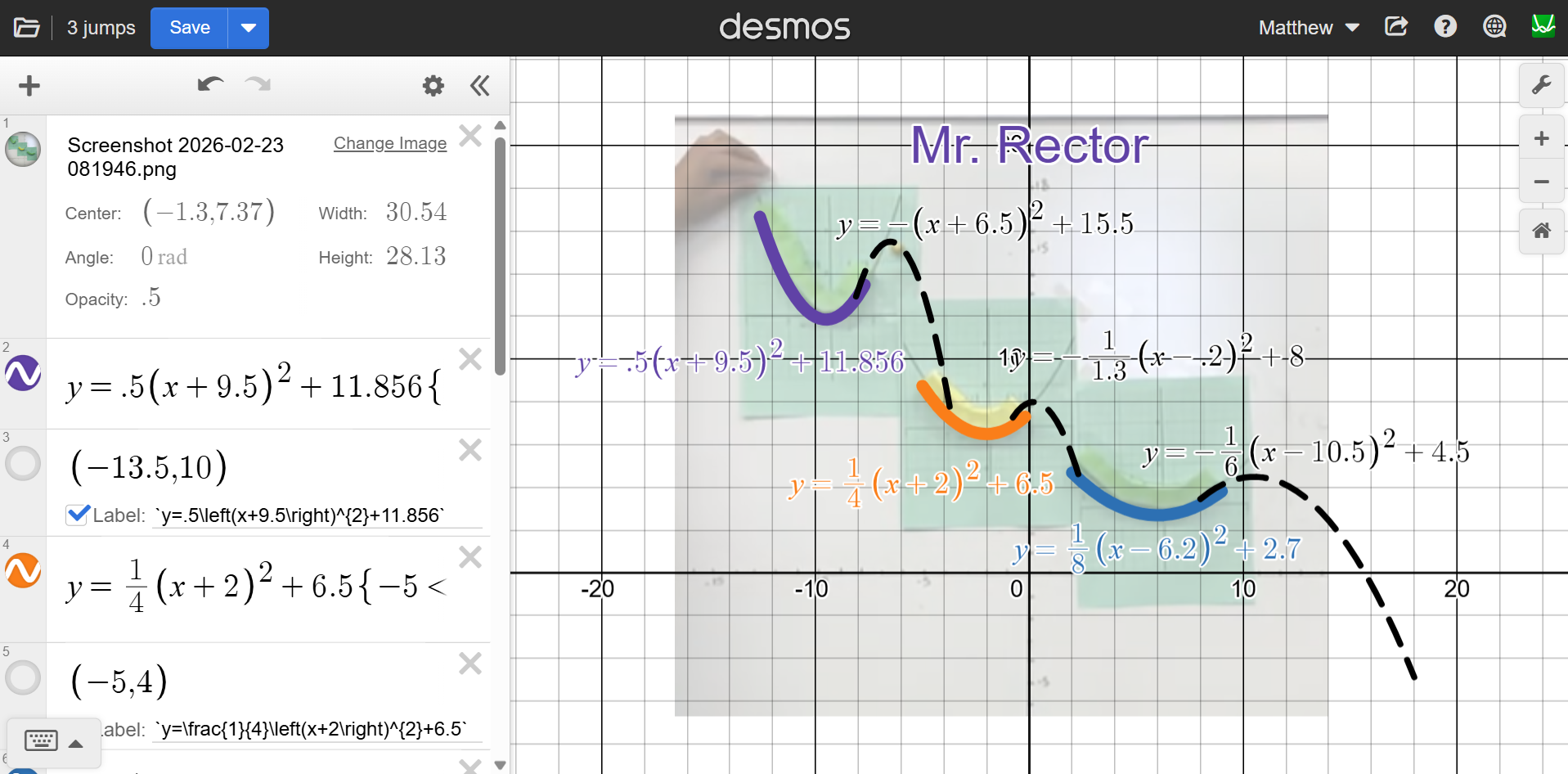
Students restrict domains to match physical start and end points and use vertex coordinates from video analysis to determine values of h and k. They then analyze and explain how changes in a, h, and k transform the parent function y=x2, including effects on width, direction, vertical shift, and horizontal shift.
Finally, students fully describe their system using:
- Domain and Range
- Continuous vs. discrete
- Maximum and minimum values
- X- and Y-intercepts
- Shape and orientation
- Presence or absence of asymptotes
The project culminates in submission of build documentation, a working video, a fully modeled Desmos graph of all six parabolas (three tracks + three flights), and written explanations of transformations.
This project integrates quadratic modeling, function transformations, mathematical structure, and real-world application into a rigorous and creative design challenge.
Common Core Standards Alignment
Integrated Math 1
Quadratic Functions
- CCSS.MATH.CONTENT.HSF-IF.B.4 — Interpret key features of functions in context (vertex, intercepts, maximum, minimum).
- CCSS.MATH.CONTENT.HSF-IF.C.7a — Graph quadratic functions and show intercepts and vertices.
- CCSS.MATH.CONTENT.HSF-BF.A.1a — Write a function that describes a relationship between two quantities.
Modeling
- CCSS.MATH.CONTENT.HSF-LE.A.1 — Distinguish between situations that can be modeled with linear or quadratic functions.
Integrated Math 2
Transformations & Structure
- CCSS.MATH.CONTENT.HSF-IF.C.8a — Use completing the square to identify maximum or minimum values.
- CCSS.MATH.CONTENT.HSF-BF.B.3 — Identify the effect of transformations on graphs of functions.
- CCSS.MATH.CONTENT.HSF-IF.B.5 — Relate the domain of a function to its graph and context.
Geometry & Modeling
- CCSS.MATH.CONTENT.HSG-MG.A.1 — Use geometric shapes and measures to model real-world situations.
Integrated Math 3
Advanced Function Analysis
- CCSS.MATH.CONTENT.HSF-IF.C.9 — Compare properties of two functions represented in different ways.
- CCSS.MATH.CONTENT.HSF-IF.B.6 — Calculate and interpret the average rate of change of a function.
Modeling with Constraints
- CCSS.MATH.CONTENT.HSF-BF.A.1 — Write a function that describes a relationship between two quantities and impose constraints.
Mathematical Practice Standards (All Courses)
- MP1 — Make sense of problems and persevere in solving them
- MP2 — Reason abstractly and quantitatively
- MP4 — Model with mathematics
- MP5 — Use appropriate tools strategically (Desmos, video analysis, templates)
- MP6 — Attend to precision
- MP7 — Look for and make use of structure
- MP8 — Look for and express regularity in repeated reasoning